How to Calculate Energy Efficiency of Electric Transport: Formulas, Examples, Savings 2026
A complete guide: learn how to calculate the cost per km for electric scooters, bikes, cars. Comparison with petrol, formulas, savings tips. Real examples for 5 vehicle types.






How to Calculate the Energy Efficiency of Personal Electric Transport: A Complete Guide for Beginners
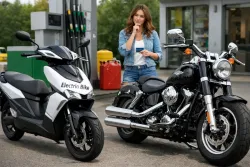
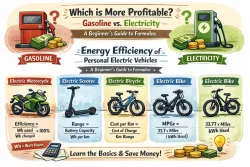
What is more profitable: petrol or electricity? Calculating the energy efficiency of personal electric transport: electric motorcycle, electric scooter, electric bicycle, electric trike. A complete guide for beginners with formulas.
You have bought an electric scooter, electric bicycle or electric motorcycle? Great! But is it really more economical than a petrol one? How to find out the real electricity costs? How much does one kilometre cost? In this article we will break down all the formulas step by step, explain each parameter and teach you how to calculate the energy efficiency of your electric vehicle on your own. Even if you are not good at maths — everything is simple here. We will give examples for different types of vehicles, compare them with petrol analogues and show you how to save thousands of euros a year.
Contents
- What is the energy efficiency of electric transport?
- The main formula for calculating costs per 1 km
- How to find out the battery capacity (simple explanation)
- How to measure real range
- Calculating costs per 1 km (step by step)
- How to convert watt-hours into money
- Comparison with petrol transport
- Calculating the cost of a full charge
- Efficiency of the charger and motor: why costs are higher
- How to calculate charging time
- How to calculate range given known consumption
li>Annual savings: how much you will save
- How to measure real consumption yourself (without special devices)
- Cheat sheet: all formulas in one place
- Calculation examples for 5 types of electric transport
- Why formulas can have errors
- How to reduce electricity consumption (practical tips)
- Influence of temperature, driving style and tyre pressure
- Calculating the payback period of electric transport
- Conclusion
1. What is the energy efficiency of electric transport?
Energy efficiency is how much energy your vehicle consumes per kilometre. It is measured in watt-hours per kilometre (Wh/km). The lower this number, the more economical the vehicle. For comparison: a good electric bicycle consumes 10-20 Wh/km, an electric scooter — 25-40 Wh/km, an electric car — 150-250 Wh/km. Understanding this indicator helps compare different models before buying, plan routes and control electricity costs.
2. The main formula for calculating costs per 1 km
The basic algorithm is as follows: you know the total battery energy and the range — you divide one by the other. But let's go step by step. We will examine each step in maximum detail so that even a person without a technical education can understand everything.
Step 1. Find out your battery capacity
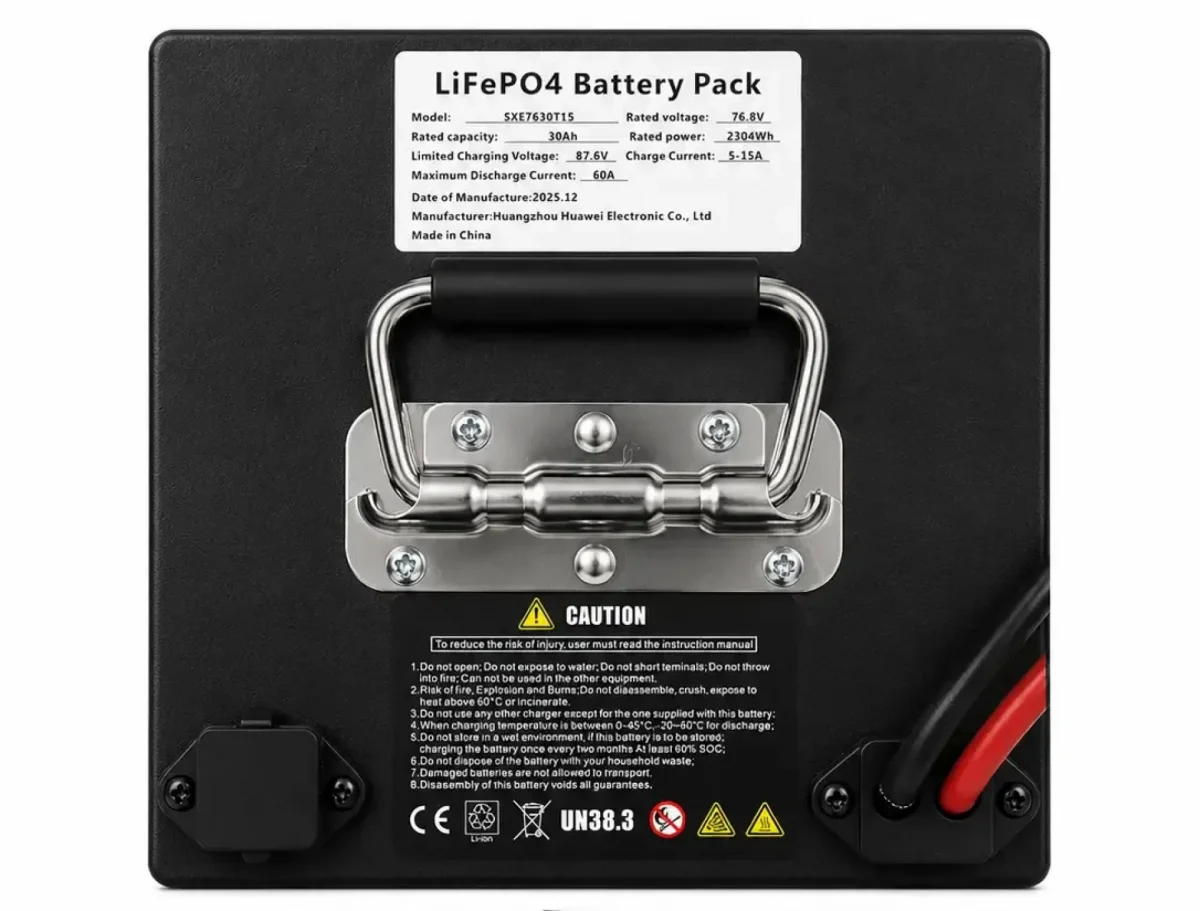
The battery (or the technical specifications) always shows two numbers: voltage (V) and capacity (Ah). Multiplying them gives you the stored energy in watt-hours (Wh). It is like the fuel tank capacity, but in electricity.
Formula: Ebat (Wh) = U (V) × C (Ah)
Example 1: battery 60V 30Ah → 60 × 30 = 1800 Wh (or 1.8 kWh).
Example 2: battery 48V 20Ah → 48 × 20 = 960 Wh.
Example 3: battery 72V 40Ah → 72 × 40 = 2880 Wh.
If the battery says only 36V 10.4Ah, then multiply: 36 × 10.4 = 374.4 Wh.
Step 2. Find out the real range
The range depends on driving style, rider weight, terrain, temperature, tyre pressure. The manufacturer often gives optimistic figures (ideal conditions: flat road, tailwind, 60 kg rider). It is better to rely on reviews from real owners or measure it yourself.
How to measure yourself: Fully charge the battery, reset the odometer (or note the mileage), ride in your usual mode until the battery is discharged (for example, to 20%). Then write down the kilometres travelled. If you rode 65 km and the battery showed 20%, then the full range is approximately 65 / 0.8 = 81.25 km. Round to 80 km.
Example: battery 60V 30Ah, you rode 80 km until full discharge — that is your real range S.
Step 3. Calculate consumption per 1 km
Formula: Ekm (Wh/km) = Ebat / S, where S is range in km.
Example: 1800 Wh / 80 km = 22.5 Wh/km. This is your energy efficiency.
The lower this value, the better. For electric bicycles a good value is up to 15 Wh/km, for scooters — up to 30 Wh/km.
3. How to convert watt-hours into money?
You need to know the electricity tariff. In Europe, the average electricity price is about €0.23 per kWh. For this guide we will use €0.25 per kWh for simplicity. For petrol we will take €1.70 per litre (average EU price at the beginning of 2026).
Cost of 1 km on electric power
Formula: Ckm (€/km) = Ekm (kWh/km) × tariff
Convert 22.5 Wh/km to kWh/km: 22.5 / 1000 = 0.0225 kWh/km.
Multiply by the tariff €0.25/kWh: 0.0225 × 0.25 = 0.005625 €/km (about 0.56 euro cents).
That is, each kilometre on this scooter costs you about 0.56 euro cents.
Cost of 1 km on a petrol analogue
Take a typical 50cc scooter that consumes 2.5 litres of petrol per 100 km. Consumption per 1 km: 2.5 / 100 = 0.025 L/km.
Cost: 0.025 L/km × €1.70/L = 0.0425 €/km (4.25 euro cents).
The difference is huge: 0.005625 € vs 0.0425 € — almost 7.6 times cheaper! If we take a more powerful petrol scooter (3.5 L/100 km), it would be 0.0595 €/km, the difference is even greater.
4. Calculating the cost of a full charge
Formula: Ccharge (€) = Ebat (kWh) × tariff
For our battery of 1.8 kWh: 1.8 × 0.25 = 0.45 € for a full charge.
For these 0.45 € you ride 80 km, so 1 km costs 0.005625 € (confirmed).
For comparison: filling a petrol scooter for 80 km would cost 80 km × 0.0425 €/km = 3.4 €. The difference is 2.95 € in favour of electricity.
5. How to account for the efficiency of the charger and motor
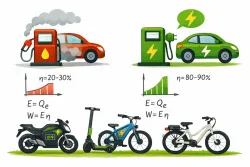
The real efficiency of the system (charger + controller + motor) is usually 80-90%. That means from the socket you consume more than the battery stores. Losses go to heat, fan operation, etc.
Formula for useful energy at the wheel: Euseful = Ebat × η, where η = 0.85 (85%).
Example: 1800 × 0.85 = 1530 Wh actually reaches the wheel, the remaining 270 Wh (15%) are lost.
But you pay for all the energy from the socket, so it is better to calculate based on the consumed energy. If you know exactly the consumption from the grid (for example, the meter showed 2.1 kWh per charge), then use that. Then the cost per 1 km will be slightly higher: (2.1 kWh × €0.25) / 80 km = 0.00656 €/km.
6. Calculating charging time
Formula: t (h) = C (Ah) / I (A), where I is the charger current.
The charger usually states output voltage and current (e.g., 60V 4A). Then t = 30 Ah / 4A = 7.5 hours. This matches the specifications of 6-8 hours.
If the current is unknown, you can measure the charging time with a stopwatch or calculate it knowing the charger power (e.g., 250 W). Then time = Ebat (Wh) / charger power (W). For 1800 Wh / 250 W = 7.2 h.
7. How to calculate range given known consumption
If you have measured real consumption (e.g., 22.5 Wh/km), then the range on a full battery:
S = Ebat / Ekm = 1800 / 22.5 = 80 km.
This is useful when you want to estimate whether the charge will be enough for a certain point. For example, to work 25 km, then 80 km is more than enough.
8. Comparison with petrol: how much you save per year
Suppose you ride 5000 km per year (typical city dweller mileage).
- Electricity costs: 5000 km × 0.005625 €/km = 28.125 €.
- Petrol costs: 5000 km × 0.0425 €/km = 212.5 €.
- Savings: 212.5 - 28.125 = 184.375 € per year.
If you ride 10000 km/year, the savings reach 368.75 €. In two years you save the price of a new electric scooter.
Add to this the absence of costs for oil, spark plugs, belts, air filters, as well as much lower maintenance costs (the electric motor hardly wears out). Payback comes even faster.
9. How to measure real consumption yourself (without special devices)
The most accurate way is to install a wattmeter (energy meter) between the socket and the charger. Such devices cost from €20 and allow you to see real consumption in kWh. Write down how many kWh were consumed during a full charging cycle. Then ride until full discharge and divide the consumed amount by the kilometres.
If you don't have a wattmeter, rely on the battery's technical data, but remember that real consumption may be 10-20% higher due to losses. You can also use an onboard computer (if available) that shows instantaneous and average energy consumption.
10. Cheat sheet: all formulas in one place
- Battery energy (Wh) = Voltage (V) × Capacity (Ah)
- Consumption per 1 km (Wh/km) = Battery energy (Wh) / Range (km)
- Consumption per 1 km (kWh/km) = (Wh/km) / 1000
- Cost per 1 km on electricity (€) = Consumption (kWh/km) × Tariff (€/kWh)
- Full charge cost (€) = Battery energy (kWh) × Tariff
- Charging time (h) = Battery capacity (Ah) / Charger current (A)
- Charging time (h) = Battery energy (Wh) / Charger power (W)
- For petrol: Consumption per 1 km (L/km) = (Litres per 100 km) / 100
- Cost per 1 km on petrol (€) = Consumption (L/km) × Petrol price (€/L)
- Annual savings = (Petrol cost per km - Electricity cost per km) × Annual mileage
11. Calculation examples for 5 types of electric transport
Example 1: Electric bicycle (48V 20Ah, range 60 km)
Ebat = 48 × 20 = 960 Wh.
Ekm = 960 / 60 = 16 Wh/km.
Cost per 1 km (tariff €0.25): 0.016 × 0.25 = 0.004 €/km (0.4 euro cents).
Charging cost: 0.96 × 0.25 = 0.24 €.
Petrol analogue (125cc motorcycle, 3 L/100 km): 0.03 × 1.70 = 0.051 €/km. Savings — 12.8 times.
Annual savings with 3000 km: 3000 × (0.051 - 0.004) = 141 €.
Example 2: Electric scooter (60V 30Ah, range 80 km)
Calculated above: 0.005625 €/km. Petrol analogue (50cc scooter, 2.5 L/100 km): 0.0425 €/km. Savings — 7.6 times. With 5000 km/year savings ≈ 184.4 €.
Example 3: Powerful electric scooter (72V 40Ah, range 100 km)
Ebat = 72 × 40 = 2880 Wh.
Ekm = 2880 / 100 = 28.8 Wh/km.
Cost per 1 km: 0.0288 × 0.25 = 0.0072 €/km (0.72 euro cents).
Petrol analogue (125cc, 3 L/100 km): 0.051 €/km. Savings — 7.1 times.
Example 4: Electric car (400V 100Ah, range 300 km)
Ebat = 400 × 100 = 40000 Wh = 40 kWh.
Ekm = 40000 / 300 ≈ 133.3 Wh/km.
Cost per 1 km: 0.1333 × 0.25 = 0.0333 €/km (3.33 euro cents).
Petrol car (8 L/100 km): 0.08 × 1.70 = 0.136 €/km. Savings — 4.1 times.
Annual savings with 15000 km: 15000 × (0.136 - 0.0333) = 1540.5 €.
Example 5: Electric scooter (36V 10Ah, range 30 km)
Ebat = 36 × 10 = 360 Wh.
Ekm = 360 / 30 = 12 Wh/km.
Cost per 1 km: 0.012 × 0.25 = 0.003 €/km (0.3 euro cents).
No petrol analogue, compare with public transport (€2 per trip). Obvious benefit.
12. Why formulas can give errors
- The manufacturer indicates battery capacity under ideal conditions (25°C, new battery). Over time, capacity decreases (after 500 cycles it can drop by 20%).
- Range strongly depends on driving style (hard acceleration, high speed). At 60 km/h consumption can be twice as high as at 30 km/h.
- In cold weather (below 0°C), lithium battery capacity drops by 20-30%, and at -20°C it can halve.
- Charger efficiency is not 100%, some energy goes into heat (e.g., 90% efficiency).
- Uphills, wind, mud, low tyre pressure increase consumption.
Therefore, for accurate calculations it is better to take practical measurements in real operating conditions.
13. How to reduce electricity consumption (practical tips)
- Maintain optimal tyre pressure (according to manufacturer's recommendations). Low pressure increases rolling resistance by 10-20%.
- Avoid hard starts and braking — smooth driving saves up to 30% energy.
- Drive at moderate speed (30-40 km/h for a scooter, 20-25 km/h for a bicycle). At high speeds, air resistance increases quadratically.
- Charge the battery in a timely manner, avoid deep discharge below 20%.
- Use regenerative braking (if available), it returns up to 10% energy.
- Keep the battery warm in winter (store indoors, insert it before the ride).
- Regularly lubricate the chain and moving parts (for bicycles).
- Reduce the weight of the cargo (unnecessary things in the trunk).
14. Influence of temperature, driving style and tyre pressure (table)
For clarity, here are approximate coefficients affecting energy consumption:
- Temperature +20°C → coefficient 1.0 (baseline)
- Temperature 0°C → coefficient 1.15 (consumption increases by 15%)
- Temperature -10°C → coefficient 1.3
- Aggressive driving (hard acceleration, speed >50 km/h) → coefficient 1.4-1.6
- Tyre pressure 0.5 bar below normal → coefficient 1.1
- Strong headwind (10 m/s) → coefficient 1.2-1.3
- 5% uphill (5 m rise per 100 m) → coefficient 1.15-1.2
15. Calculating the payback period of electric transport
Suppose you bought an electric scooter for €1000. Petrol costs for an equivalent petrol scooter per year (5000 km) = 212.5 €. Electricity costs per year = 28.125 €. Fuel savings per year = 184.375 €. Plus no costs for oil (approx. €25/year), spark plugs (€5), belts (€12) etc. Total savings over €220/year. Payback period = 1000 / 220 ≈ 4.5 years. But if we take into account that a petrol scooter also costs money (e.g., €600), the price difference of €400 pays back in about 1.8 years. After that, pure savings.
16. Conclusion
Calculating the energy efficiency of electric transport is simple: knowing the voltage, capacity and range, you can find out the cost of each kilometre. At prices of €0.25 per kWh and €1.70 per litre of petrol, electric transport is 4 to 13 times cheaper depending on the type. Use our formulas to compare different models before buying or simply to control your costs. And most importantly — you get not only savings, but also the pleasure of quiet, powerful and eco-friendly riding. This guide covers all the main aspects of calculations. Now you can independently plug in your battery parameters, range, local electricity tariff and petrol price and find out how much you really save. Happy and safe travels!