
Crosser TR5 Pro LFP (advanced modification) review and comparison with TR-5
Comparative analysis of a three-wheeled, cargo-passenger electric scooter, a table of characteristics of the basic Crosser TR-5 model and the "Crosser Transit TR-5 Pro LFP" configuration

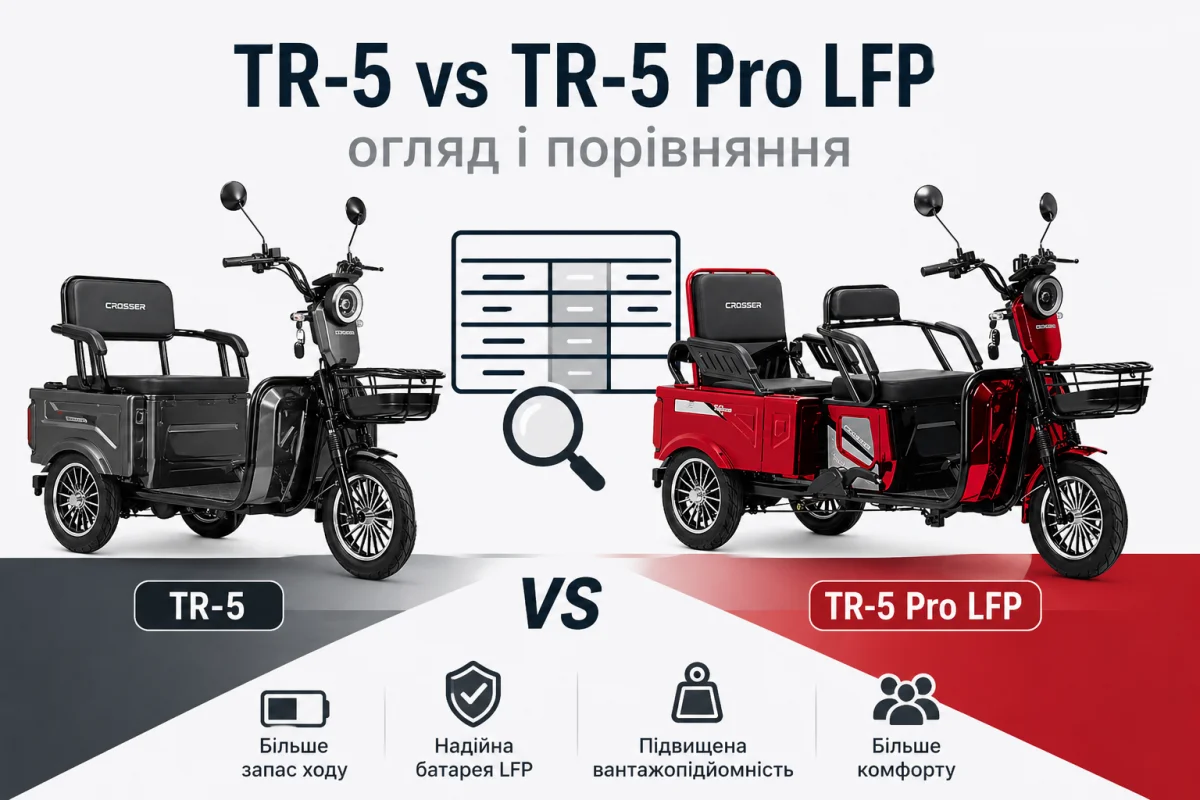
Crosser TR5 Pro LFP and comparative analysis with the base model TR-5.
1. Product presentation
Crosser Transit TR-5 PRO electric trike (1500W • 76.8V • 30Ah LiFePO4) 45 km/h, range 70 km, 2026 is an improved version of the popular cargo-passenger tricycle. The model is designed for intensive commercial use and long trips, offering increased power, a modern battery type, and improved ride quality.
2. Development history and positioning
The base model Crosser Transit TR-5 has proven itself as a reliable solution for small businesses and private use. Based on four years of operating experience and feedback from owners, the Pro LFP version was created. By analyzing reviews from open sources, a number of typical comments about the base model can be identified, which were taken into account in the development of the Pro version.
Thus, owners of the TR-5 Transit model (presumably with a graphene battery) pointed out some features: for example, the actual range was often lower than stated, and the display indication could be insufficiently informative. Respondents also reported the need to refine the battery mount to prevent shifting when driving on uneven roads and to tighten the fasteners after purchase. At the same time, the availability of free space in the battery compartment was particularly noted, which directly implied the possibility of installing more advanced lithium-iron-phosphate (LiFePO4) batteries.
The Pro LFP model is a direct response to these wishes. It corrected the noted shortcomings and introduced key improvements aimed at increasing reliability and performance.
3. Crosser TR5 Pro LFP: Key components and applications
3.1. Powertrain, chassis and electronics
- Motor type and drive: Brushless DC motor (BLDC) with a nominal power of 1500 W. Rear drive provides optimal weight distribution and better traction when transporting goods, especially on inclines. The presence of three speed modes allows the driver to flexibly control power.
- Battery (LFP): A lithium-iron-phosphate (LiFePO4) battery pack with a nominal voltage of 76.8 V and a capacity of 30 Ah is installed. Compared to traditional lead-acid or graphene batteries, LFP cells provide 3-5 times longer life (2000–3000 charge-discharge cycles vs. 300–500), higher peak current output, stable voltage under load, as well as complete fire safety and resistance to overheating. The unit is sealed and maintenance-free.
- Suspension and wheels: Full suspension with front (fork type) and rear shock absorbers, which is critical for smooth running on broken roads and when transporting fragile goods. Wheels are pneumatic type 3.00-10 (10 inches), providing good cushioning and traction.
- Frame and load capacity: The frame is made of thick-walled rectangular steel tube, which provides high torsional rigidity. Maximum load — 220 kg.
- Braking system: Hydraulic disc brakes on all three wheels with combined handlebar (hand lever) and foot pedal controls that duplicate the rear circuit. This scheme allows more effective distribution of braking force and provides backup in the event of a circuit failure.
- Lighting and alarm: LED optics (headlight with low/high beam, side lights, stop light, dynamic turn signals with sound indication and hazard lights). Remote immobilizer and audible alarm.
3.2. Ergonomics and functionality
- Convertible rear seat: The two-person rear seat folds down in seconds, forming a flat cargo platform with sides. This allows the tricycle to be used in two fundamentally different roles: passenger (4 seats including driver) and cargo (baggage compartment volume over 300 liters).
- Weather protection: A full cabin with a windshield (equipped with a wiper), a hard roof with LED interior lighting, and a removable tarpaulin cover that encloses the rear passenger/cargo compartment.
- Driver and passenger comfort: Ergonomic driver's seat with adjustable backrest, anatomical rear seat, wide armrest for the driver. Information panel: colour LCD display showing speed, battery charge level, voltage, distance travelled and selected speed mode.
- Luggage solutions: Woven metal basket on the front panel for bags or small items, as well as a roof rack for carrying long loads.
3.3. Applications
- Courier services and delivery: The convertible body and long range make the scooter ideal for delivering food, goods, documents, and medicines.
- Small business and trade: A mobile point for vending pastries, drinks, vegetables, souvenirs.
- Public utilities: Transportation of tools and equipment for cleaning services, repair teams, landscaping services.
- Cottage and farming: Transporting seedlings, feed, small building materials off-road, garbage removal.
- Passenger transport: Unlicensed shuttle on closed territories (campgrounds, tourist bases, airports) or tourist transport.
4. Detailed technical specifications
Table 1. Comparative table of characteristics of Crosser TR-5 (base) and Crosser TR5 Pro LFP
Maximum load, kg
| Parameter | Crosser Transit TR-5 (base) | Crosser TR5 Pro LFP Transit |
| Powertrain | ||
| Motor type | Brushless (BLDC) | Brushless (BLDC) |
| Rated motor power, W | 800–1200 (depending on modification) | 1500 |
| Peak power, W | up to 2000 | 2500–3000 |
| Drive | Rear / on axle | Rear |
| Speed modes | 3 | 3 |
| Battery | ||
| Battery type | Lead-acid AGM / Graphene | LiFePO4 (lithium-iron-phosphate) |
| Nominal voltage, V | 72 | 76.8 |
| Capacity, Ah | 20–24 (depending on modification) | 30 |
| Energy capacity, kWh | 1.44–1.73 | ~2.30 |
| Cycle life (charge-discharge cycles) | 300–500 (for graphene) | 2000–3000 |
| Full charge time, h | 6–8 | 4–6 |
| Driving performance | ||
| Maximum speed (limited), km/h | 40–45 (according to passport) | 45 |
| Range (max.), km | 60–80 | 70 |
| Geometry and weight | ||
| Length, mm | 1960 | 1960 |
| Width, mm | 710 | 710 |
| Height, mm | 980 | 980 |
| Wheelbase, mm | 1770 | 1770 |
| Ground clearance, mm | 150 | 150 |
| Curb weight, kg | ~170 | ~137 |
| 250–500 | 220 | |
| Suspension and wheels | ||
| Suspension type | Rear (two shock absorbers) | Front and rear |
| Tyre size | 3.00-10 (10") / 14" (optional) | 3.00-10 (10") |
| Tyre type | Pneumatic | Pneumatic |
| Ergonomics and functionality | ||
| Number of seats | 2 + 2 (transformer) | 2 + 2 (transformer) |
| Convertible seat | Yes | Yes |
| Brake system type | Drum / Disc | Hydraulic disc (3 circuits) |
| Cabin (awning) availability | Yes (removable) | Yes (removable) |
| Frame material | Steel | Steel |
| Warranty, months | ||
| Warranty, months | 24 | 24 |
| Estimated retail price (Ukraine, 04.2026), UAH | 39,382 (base) – 46,999 | ~67,000 |
5. Comparative analysis
Power and performance: The Pro LFP version increases power by 25-30% compared to the top version of the base model. The higher voltage (76.8 V) slightly reduces the current in the circuit, which has a positive effect on heat dissipation and efficiency. The range of the base model strongly depends on load and driving style (actual 40–50 km), while with the Pro LFP even under active use, a confident 55–60 km can be expected.
Battery: This is the most important difference. The transition from graphene or AGM batteries to LFP dramatically increases reliability and durability. The life of an LFP battery will be enough for about 8 years of daily use (one full charge cycle per day), while a graphene battery degrades in 1.5–2 years. In addition, LFP is lighter: the curb weight of the Pro LFP is almost 40 kg lower, which improves dynamics and reduces wear on the running gear. At the same time, the maximum load decreased from 500 kg to 220 kg, which is a compromise, but for the vast majority of real-world tasks, 220 kg is more than enough.
Suspension and chassis: The addition of front shock absorbers is another significant improvement in the Pro LFP. It fundamentally changes the behavior of the tricycle on uneven roads, reducing steering vibration and driver fatigue.
Functionality: Both models are equipped with a folding rear seat, but the Pro LFP features a more thoughtful design of locks and hinges. The overall build quality is higher: thicker frame metal and reinforced suspension components are used.
Conclusion: The base TR-5 model is an affordable all-rounder with compromise characteristics. The Pro LFP is already a professional tool designed for intensive and long-term use.
6. Technical aspects, operation, maintenance and safety
To keep the LFP battery in optimal condition, several simple rules should be followed: charge from 20% to 80–90%, because full cycles (0→100%) exhaust the resource much faster; do not store at 100% charge for more than a few days; charge at positive temperatures.
Lubrication of suspension joints and steering column – every 6 months (lithium grease). Adjustment of brake cables and gear shifting – as they loosen.
Safety: The design of the tricycle with a low centre of gravity and a wide rear axle makes overturning virtually impossible. Tyres should always be inflated to 2.2–2.5 bar. It is recommended to equip the scooter with reflective elements or a yellow flashing beacon.
7. Modifications and conclusion
It is possible to install a larger capacity battery (40 Ah), which will increase the range to 100 km. The body colour choice is available: black, white, red, blue, dark grey metallic. On request, one of the rear shock absorbers can be replaced with a hydraulic one with a gas spring.
Crosser TR5 Pro LFP is a step forward compared to the base model, turning the tricycle from a simple vehicle into a reliable commercial tool. The hybrid design, LFP battery, reinforced chassis and convertible body create a unique market offer that has virtually no direct competitors in terms of price-quality ratio.
